
Investing does not have to feel complicated. While there are many financial products and strategies available, understanding the basic role each option may play can make financial decisions easier.
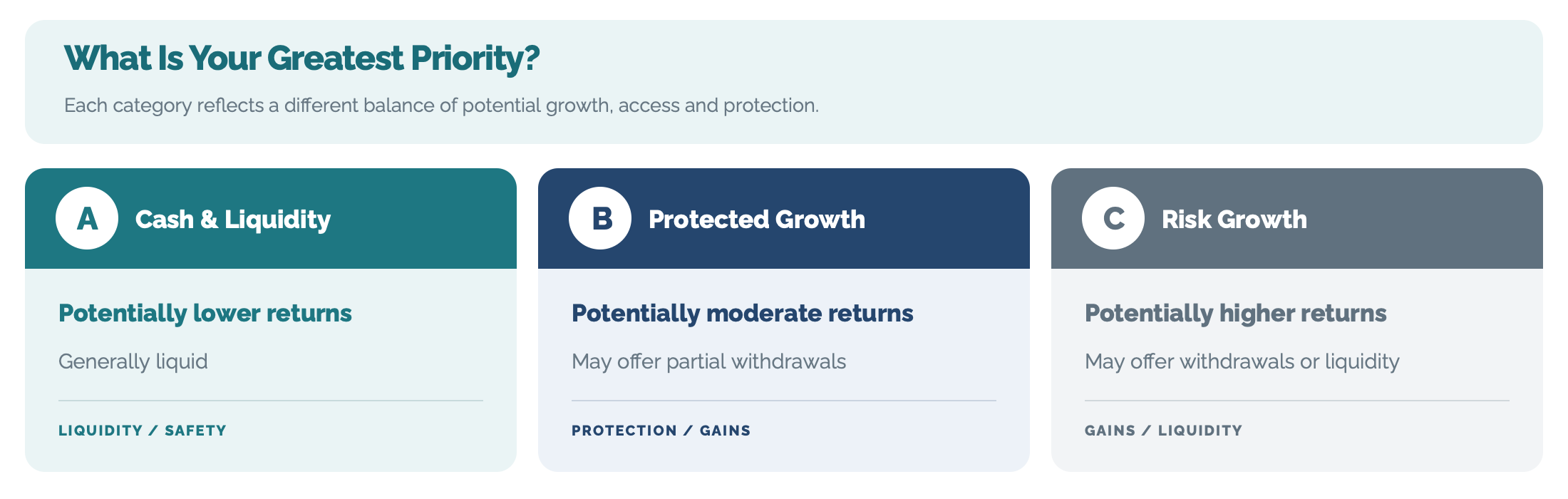
At FMS Financial Services, we use the ABC Planning Process to organize financial choices according to three important considerations: growth potential, access to money and protection. Each category offers a different balance of these priorities—and comes with its own trade-offs.
The goal is not to choose one category over the others. It is to determine which combination may be appropriate for your goals, time horizon, income needs, comfort with market risk and desired level of access to your money.
A: Cash and Liquidity
The “A” category focuses primarily on liquidity and safety. These options generally provide easier access to your money and a greater degree of principal protection, but they may offer lower growth potential.
Common examples may include:
Savings accounts
Money market accounts
Certificates of deposit
Bank and credit union assets
Government bonds
Certain fixed annuities
This category may be useful for emergency savings, short-term expenses or money that you may need to access relatively soon.
Prioritizes: Liquidity and safety
Primary trade-off: Growth potential
B: Protected Growth
The “B” category is designed to balance protection with the potential for moderate growth. These options may provide certain guarantees or protection features, although access to money can be more limited than it is in the “A” category.
Common examples may include:
Fixed indexed annuities
Whole life insurance
Universal life insurance
Depending on the product, partial withdrawals may be available. However, surrender charges, withdrawal restrictions, taxes or other limitations may apply.
Prioritizes: Protection and growth potential
Primary trade-off: Liquidity
C: Risk Growth
The “C” category emphasizes growth potential and may provide liquidity, but it also involves greater exposure to investment risk. Account values can fluctuate, and investors may lose some or all of the principal invested.
Common examples may include:
Stocks and bonds
Mutual funds and exchange-traded funds
Managed accounts
Real estate investment trusts
Unit investment trusts
Variable annuities
Options and other market-based investments
These investments may be more appropriate for longer-term goals and for investors who are comfortable accepting market fluctuations in pursuit of potential growth.
Prioritizes: Growth potential and liquidity
Primary trade-off: Protection
How the FMS ABC Planning Process Works
Your financial strategy may include assets from more than one ABC category. Our role is to help you understand the available choices, evaluate their trade-offs and develop a mix that reflects your individual circumstances.
1. Investigate
We begin by learning about you. This includes discussing your financial goals, current assets, income needs, time horizon, family circumstances, comfort with risk and the amount of access you may need.
We also review how your existing accounts and financial products fit together. This helps identify potential gaps, unnecessary overlap and areas that may deserve additional attention.
2. Recommend
After gathering the necessary information, we develop recommendations based on your priorities. We explain how the proposed mix of liquidity, protection and growth potential is intended to support your goals.
This conversation also includes the trade-offs involved. No single investment provides maximum growth, complete protection and unrestricted access at the same time. Understanding those trade-offs is an important part of making an informed decision.
3. Implement
Once you understand the recommendations and decide how you would like to proceed, we help put the strategy into action.
Implementation may involve coordinating account paperwork, allocating assets among appropriate categories and helping ensure that each part of the strategy has a clearly defined purpose.
4. Review and Rebalance
Financial planning is an ongoing process. Your goals, income needs, family circumstances and comfort with risk can change over time. Markets, interest rates and available financial products can change as well.
We review the strategy regularly and discuss whether adjustments or rebalancing may be appropriate. This ongoing process helps keep the plan aligned with your priorities as your life evolves.
Your Financial Plan Should Be Personal
The appropriate ABC mix will be different for every investor. Some people need to prioritize access to their money. Others may place greater emphasis on protection, income or long-term growth.
The ABC Planning Process provides a straightforward way to begin that conversation. By understanding what each category is designed to do—and what it may require you to give up—you can make financial decisions with greater clarity and confidence.
Ready to explore what your ABC mix could look like? Contact FMS Financial Services to start the conversation.
The ABC Planning Process is an illustrative planning framework.
Securities offered through Packerland Brokerage Services, Inc., an unaffiliated entity
Information Only
The information provided in this document is intended for informational purposes only and is not a solicitation to purchase or sell any security.